Clearing 1
The First Clearing
The clay golem, the stone beetle and the copper bird wake here, one after another. Every job is done by writing the lines out, a few at a time, so the first ideas have room to settle.
New ideas
- print and text in quotes
- Commands with arguments, and tiles as (x, y)
- Lines that run in order
- Names for values
- Asking the tile
- if, True and False
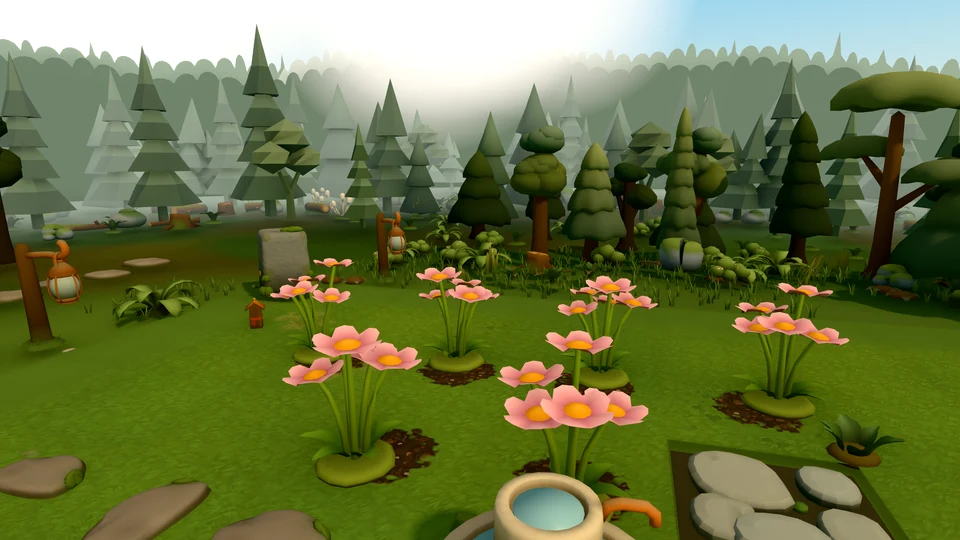
The stone beetle takes a step, and pulls only where a weed grows:
forward()if sense("weed"): pull_weed()Clearing 2
The Tangled Hollow
The three creatures work in turn: the golem soaks the baked ground under the thorns, the beetle follows the wet trail pulling them, and the bird gathers the fruit they freed. The jobs here are long enough to want a loop.
New ideas
- Kinds of data: numbers, text, pairs and lists
- for loops
- Walking to a whole spot
- Counting from 0
- while loops
- Turning
- The pot and refill()
The golem's pot runs dry halfway along the bed, so the program stops at the fountain between two loops:
move_to(7, 2)refill()for spot in bottom:Clearing 3
The Stone Terraces
The terraces repeat themselves, row after row, so this is where a program first gets named parts of its own.
New ideas
- def
- not, and walking to the wall
- A new value for a name
The beetle's sweep, written once and given a name, so it can be called for every row:
def sweep(): while not at_wall(): forward() if sense("weed"): pull_weed()Clearing 4
The Forked Path
Every fruit has to go to its own basket, so the programs here start making choices.
New ideas
- sense() and dictionaries
- What a scan hands back
- Comparing numbers
- holding and ==
- and, or
- else
- elif
Inside the bird's loop, each fruit goes where it belongs:
if holding == "pear": fly_to(1, 1)elif holding == "melon": fly_to(8, 1)else: fly_to(4, 8)Clearing 5
The Counting Brook
The bird lays stepping stones across the ford, and the brook wants to know how many it took.
New ideas
- A name that changes
- Sums
One more stone each time round the loop, and the total said at the end:
count = count + 1log(count)Clearing 6
The Hundred Steps
A hill of ten terraced rows, three flowers on each, and a summit at the top.
New ideas
- range()
- range() with a start and a step
- A loop inside a loop
The bird carries a seed up the steps, counting down from row 10 to row 0:
pick_up()for row in range(10, -1, -1): fly_to(4, row)drop()Clearing 7
The Gathering Ledger
An orchard of mixed fruit, and a function that plans the bird's route for any one kind.
New ideas
- A parameter
- [] and append
- return
- len()
- in
Ask for a kind of fruit and get back a list of where each one lies:
def plan(kind): ledger = [] for f in scan(9): if f["kind"] == kind: ledger.append(f) return ledgerClearing 8
The Night Garden
Rows that run as long as they run, and a journal to write in at the end of the night.
New ideas
- == and != on text
- while True and break
- f-strings
- An empty list, and found[0]
The golem walks the moonflower row until it reaches the path, however long the row is:
while True: move_to(col, 9) if sense()["type"] == "path": breakand then writes the night's first journal line:
log(f"{count} moonflowers are open")After the clearings
Wild Gardens
Generated gardens for practice. They open after the Stone Terraces and only ask for ideas you have already met. A seed code grows the same garden for everyone, so a class can work on one together.
The Keeper's Garden
Your own garden once the clearings are done, laid out by a Python program of your own that the game keeps.
Not in the game yet
Some things a beginner course covers are not taught here yet: input(), working with text, slicing, writing your own dictionaries, try and except, and classes.